
Skip to content

Sauerkraut & Apple Slaw

A 10-minute raw slaw that layers live sauerkraut with crisp apple, carrot, and a bright lemon-olive oil dressing — no cooking required.

Jump to recipe
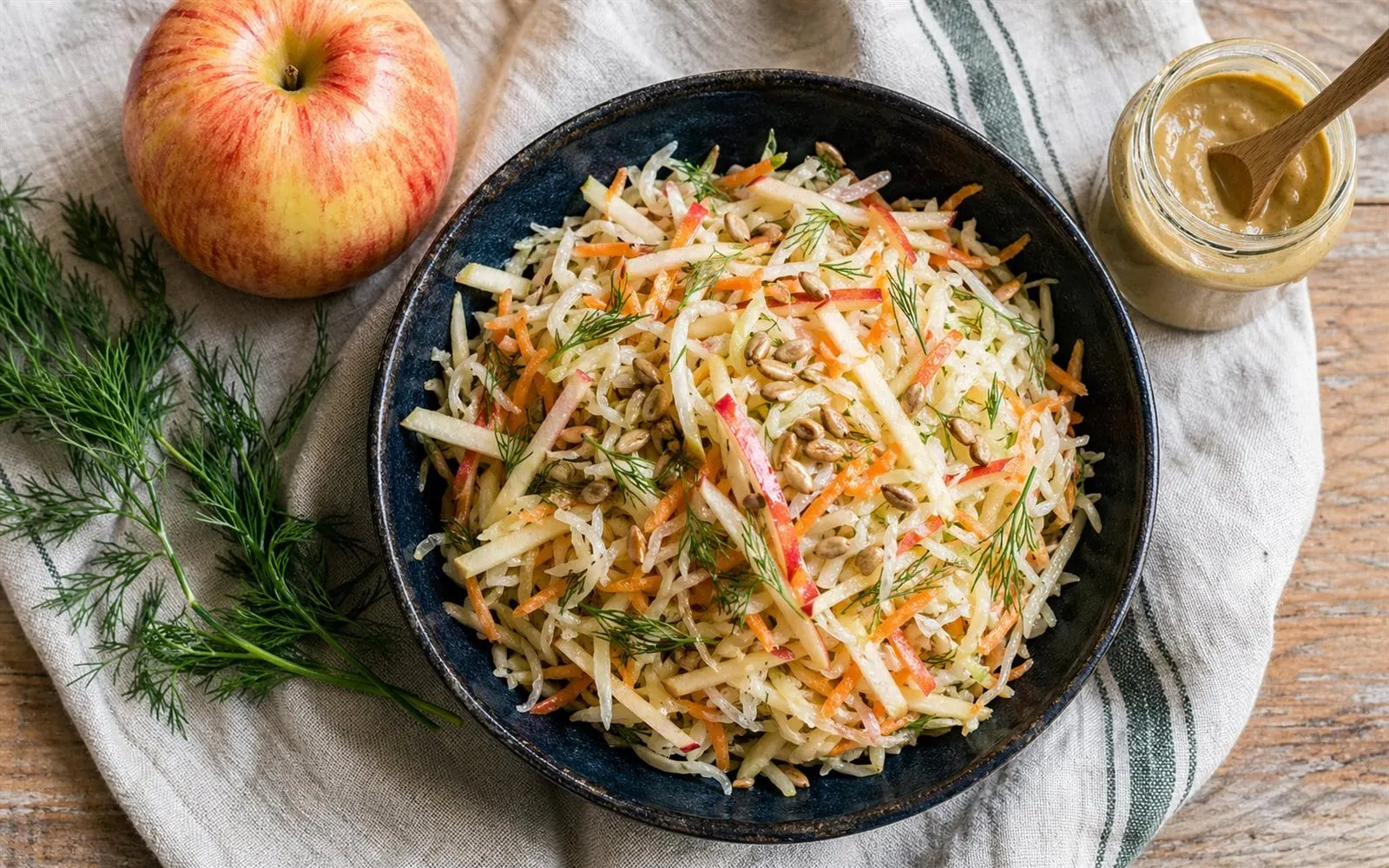
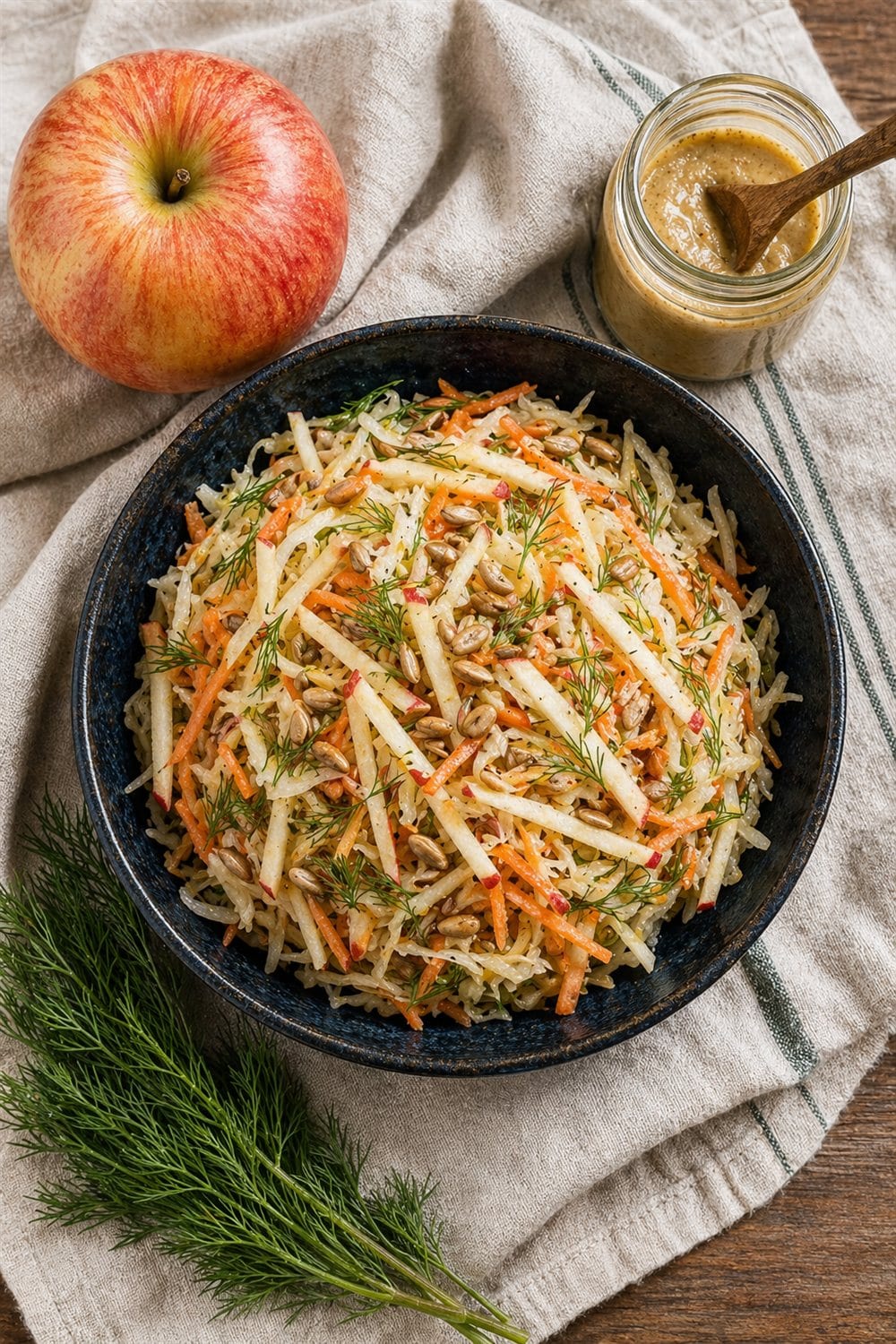
Sauerkraut & Apple Slaw — GutPlate recipe photo
Prep
10 min
Cook
Total
10 min
Serves
4 small side servings

Why you'll love this recipe

  • 10 minutes, no cooking — the easiest fermented-food side you'll ever make.
  • Live Lactobacillus and Pediococcus straight from the kraut — a clinical-grade probiotic dose in 3 tablespoons.
  • Crunchy apple and carrot balance the tang; dill makes it taste fresh, not funky.
  • Vegan, gluten-free, dairy-free — pairs with anything.
  • Scales up easily for parties or holidays — bring a beautiful bowl and no one will know it's 'the probiotic dish.'
  • Uses pantry staples + one fresh vegetable. A great way to make kraut disappear off your shelf.

Raw sauerkraut is one of the cheapest, most concentrated sources of live probiotics you can buy, and the single easiest way to get it into your day is a slaw. The combination here is intentional: crisp apple and grated carrot take the edge off kraut’s acidity, fresh dill adds a garden-y brightness, and a whisper of Dijon ties the dressing together without overpowering the culture. Ten minutes of chopping gives you a side dish that punches far above its weight — a gut-health intervention that reads as a dinner-party plate.
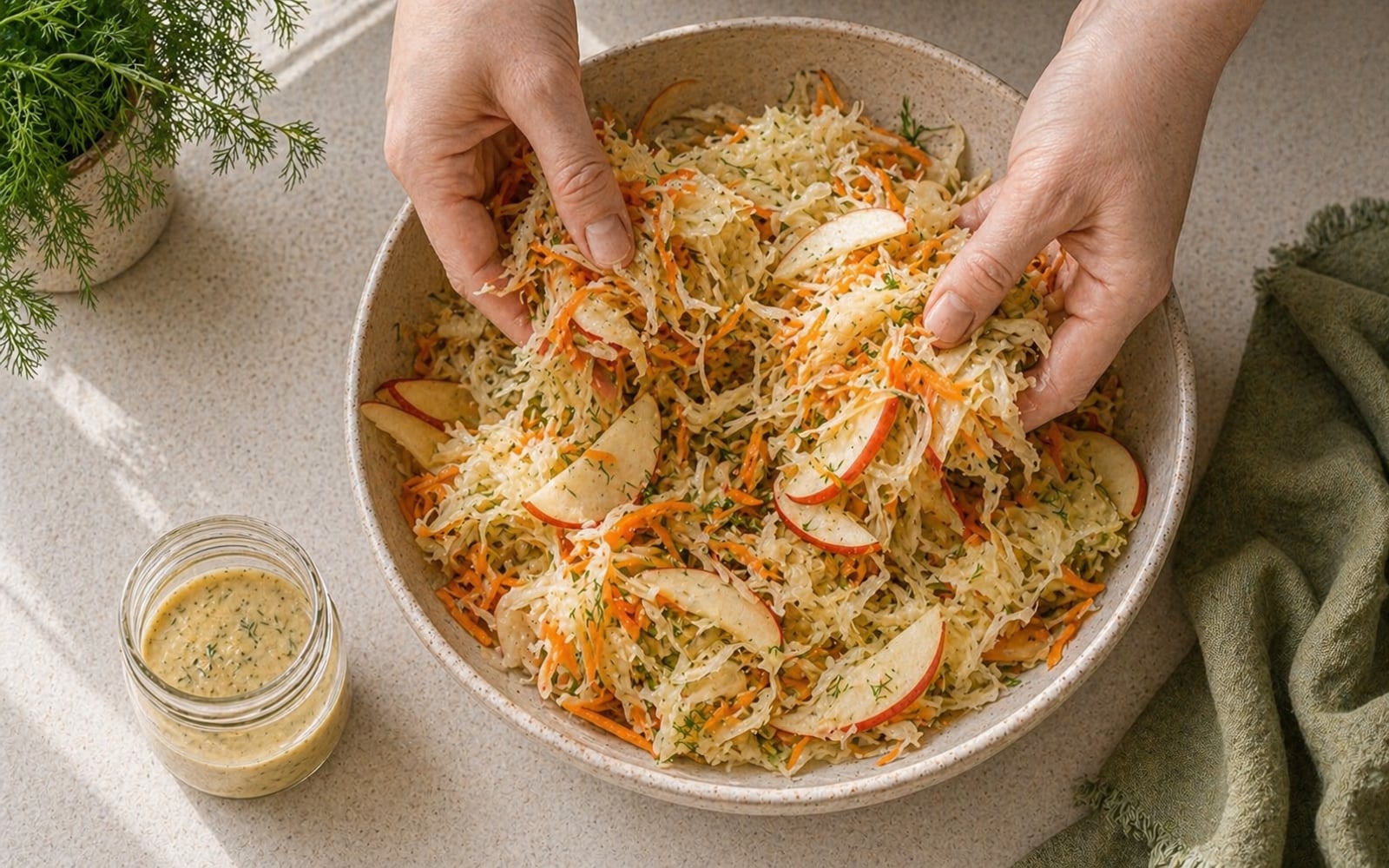
Hands tossing shredded sauerkraut, thin apple slices, and grated carrot in a wide bowl with a Dijon-dill dressing.

The recipe takes ten minutes and holds well enough to prep in the morning and serve at dinner, though fresher is better. A few ground rules make the difference between a useful probiotic side and a salty cabbage decoration. Look for sauerkraut stored in the refrigerated section with a label that says live, raw, or unpasteurized — shelf-stable jars have been heat-treated and no longer carry the organisms you’re eating it for. Drain the kraut instead of rinsing it so you keep the tangy brine and the concentrated bacteria close to the vegetables. And choose an apple with the skin on — that’s where the pectin fiber lives, which is what your gut bacteria will ferment once they get past the stomach.

If fermented foods are new to you, start with a two-tablespoon portion and build from there. Your microbiome adjusts quickly, but it adjusts better when you don’t overwhelm it on day one. Two weeks in, you’ll probably find yourself eating this at every other dinner — as a side to roast chicken, as a topping on grain bowls, even as a quick lunch with some cheese and bread. A tiny habit with outsized results.
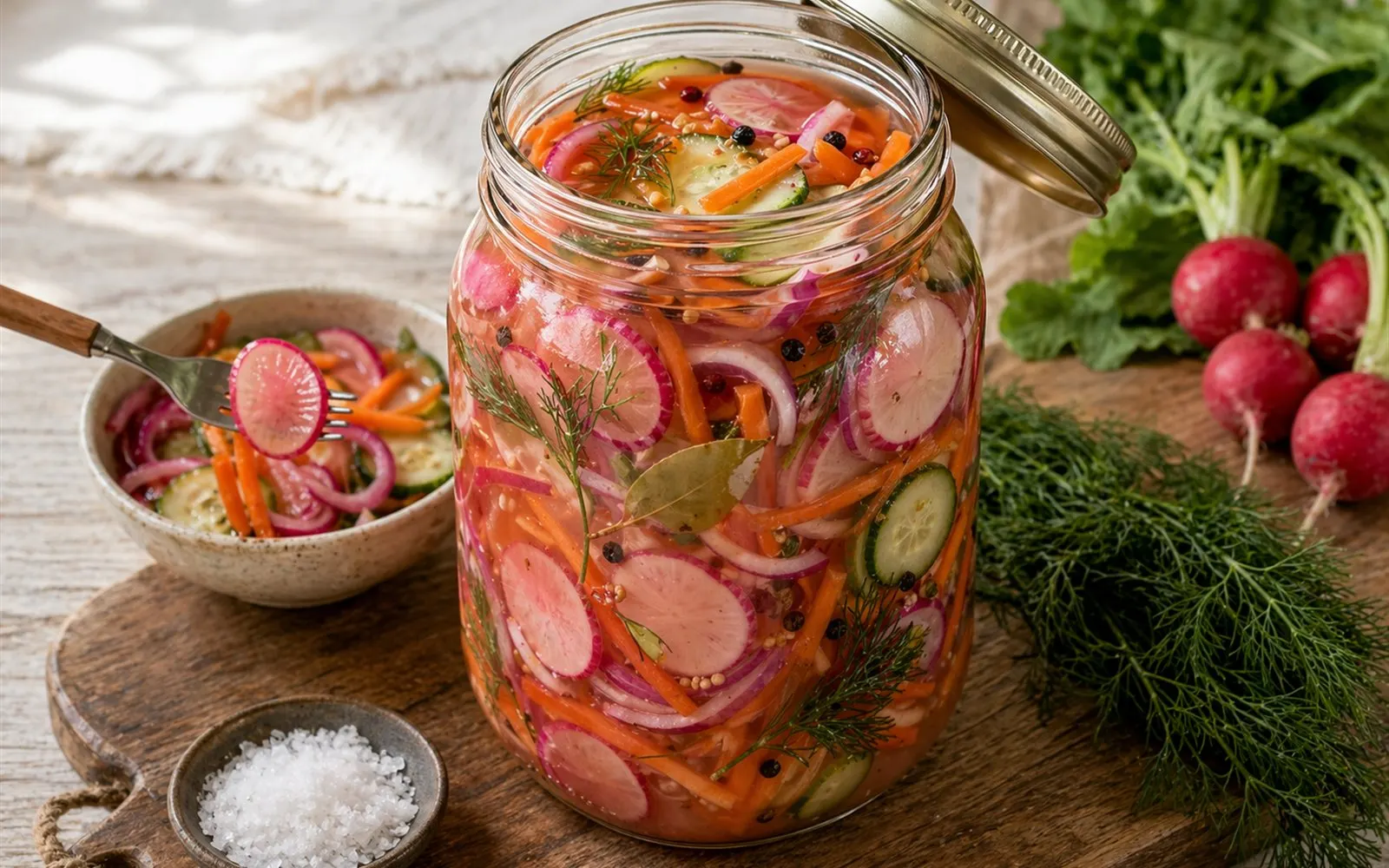
Key ingredients

Why these ingredients

Raw sauerkraut

One of the most probiotic-dense foods you can buy, full stop. A single tablespoon of real, refrigerated, unpasteurized kraut carries more live cultures than most probiotic supplements. The specific strains — Lactobacillus plantarum, L. sakei, Pediococcus — are also particularly well-studied for gut-health outcomes.

Honeycrisp apple (julienned, skin on)

The skin holds most of the apple's pectin — a soluble fiber that's preferentially fermented by Akkermansia muciniphila in the colon. Julienning rather than dicing gives you the right crunchy-stringy texture that matches the kraut.

Carrot (grated)

Adds sweetness, color, and beta-carotene (which your body converts to vitamin A — critical for gut lining health). Also contributes insoluble fiber that helps bulk stool and regularize transit time.

Fresh dill

Dill's essential oils (carvone, limonene) have mild antimicrobial properties that paradoxically benefit gut health by selectively reducing pathogenic bacteria without harming beneficial ones. It also pairs naturally with kraut — a classic Eastern European combination.

Extra-virgin olive oil

Not just dressing — EVOO's polyphenols (oleocanthal, hydroxytyrosol) have documented anti-inflammatory effects at the colonic mucosa. Using good oil (the kind that peppers your throat slightly) matters more than the quantity.

Before you start

Equipment

  • Large mixing bowl

    for tossing — wide so you can distribute dressing without crushing the kraut

  • Box grater

    for the carrot — use the large-hole side

  • Sharp chef's knife

    for julienning the apple — try to make matchsticks, not wedges

  • Fine-mesh sieve

    for draining the kraut cleanly

Recipe card

Sauerkraut & Apple Slaw

Prep
10 min
Cook
0 min
Total
10 min
Servings
4

Ingredients

Instructions

Notes

  • Use refrigerated, unpasteurized sauerkraut — shelf-stable jars have been heat-pasteurized and no longer carry live cultures. Look for 'raw', 'unpasteurized', or 'contains live cultures' on the label.
  • Keeps 2 days in the fridge. The apple softens slightly but the kraut stays crunchy.
  • Pairs with roast chicken, smoked fish, sausage, or a hearty grain bowl. It's a side that punches above its weight.

Nutrition per serving

Estimated; see our disclaimer.

Cal
120 kcal
Protein
1 g
Carbs
10 g
Fat
8 g
Fiber
3 g
Sugar
6 g
Sat Fat
1 g
Sodium
380 mg
Calcium
40 mg
Iron
1 mg

From our test kitchen

Pro tips

Drain, don't rinse

Rinsing sauerkraut washes away the live cultures you're paying for. Drain in a fine-mesh sieve for 2 minutes, reserve a tablespoon of brine for the dressing, and you keep the probiotic punch.

Skin on the apple

The peel carries most of the apple's pectin fiber. Julienne the apple with the skin on — it also adds a pop of color. Honeycrisp, Granny Smith, or Pink Lady hold their shape best.

Toast the sunflower seeds

Raw seeds taste like nothing; toasted seeds taste like something. Toast 1/4 cup in a dry skillet over medium heat for 3 minutes, shaking the pan, until golden. Store extras in a jar — they keep 2 weeks.

Rest 5 minutes, not more

A 5-minute rest lets the dressing penetrate the vegetables and flavors meld. More than that and the apple starts browning (oxidation) and the slaw gets watery. Make it just before serving, not hours ahead.

When things go sideways

Troubleshooting

Slaw tastes aggressively sour.

Your kraut is old (brine gets more acidic with age) or you used too much. Taste it straight from the jar first; if it's punchy, halve the amount and add more apple. A pinch of honey in the dressing can balance it.

Apple turned brown within 20 minutes.

Oxidation. Prevent next time by tossing the julienned apple with the lemon juice IMMEDIATELY after cutting, before adding to the bowl. Honeycrisp oxidizes slower than most varieties.

Slaw is watery at the bottom.

You didn't drain the kraut enough. Next time, drain in a sieve for 3 full minutes, pressing gently with a spoon. If it's already made, lift the slaw to a new bowl and leave the pooled liquid behind.

Can't taste the herbs.

Dill stems are woody and flavorless — only use the tender fronds. Chop them finer than you think; a big pile of fronds releases more aroma than a small pile.

The slaw tastes one-note (just sour).

Almost always missing fat or sweetness. Add 1 more teaspoon of olive oil or a drizzle of honey. The slaw needs a balance of tangy/sweet/fatty/salty to sing.

Keep it fresh

Storage & reheating

Make ahead

Can prep components 1 day ahead: drain kraut, julienne apple (toss with lemon juice to prevent browning), grate carrot, chop dill. Whisk dressing. Combine only at the last moment before serving.

Fridge

Keeps 2 days in a sealed container. The apple softens slightly but the kraut stays crunchy and the probiotics remain live. Not a make-way-ahead dish — best within 24 hours of mixing.

Freezer

Don't. Freezing destroys the texture and kills the probiotics. This is a cold, fresh preparation only.

Reheat

Never heat. Warming above 115°F kills the live cultures you're eating this for. If someone asks for 'warm slaw' they're asking for a different recipe.

Make it yours

Variations

Kimchi version

Swap sauerkraut for 1 cup of chopped kimchi (mild variety). Skip the dill, add 1 thinly sliced scallion (greens only), and replace the Dijon with 1 teaspoon of gochujang. Korean-American crossover.

Beet-forward

Add 1 small cooked-and-diced red beet to the mix. Turns the whole slaw bright magenta and adds sweetness + earthy depth. Pairs beautifully with smoked salmon.

Pear and fennel

Swap the apple for 1 thinly sliced ripe pear, and replace the carrot with 1/2 of a thinly shaved fennel bulb. More elegant; serves as a first course rather than side.

Low-FODMAP (strict)

Halve the sauerkraut to 1/2 cup total and use only 2 tablespoons per serving. Use Honeycrisp apple (low-FODMAP at 1/4 apple per serving). Skip the Dijon if it contains garlic/onion (most don't — check the label).

Heartier lunch version

Double everything and add 1 can of drained chickpeas + 2 ounces of crumbled feta. Turns it from a side into a full meal. Pairs well with grilled bread.

Pantry swaps

Ingredient substitutions

Instead of

Raw sauerkraut

Use

Raw kimchi (mild), kvass-fermented carrots, or naturally-fermented pickles

Any live, unpasteurized ferment works. Kimchi adds heat; fermented carrots are mild and beginner-friendly.

Instead of

Honeycrisp apple

Use

Pear, fennel, kohlrabi, jicama, or thinly sliced raw beet

Kohlrabi is underused — mild, crunchy, peppery. Worth seeking out.

Instead of

Carrot

Use

Purple carrot, daikon, or thinly sliced red radish

Purple carrot adds polyphenols and dramatic color. Radish adds peppery bite.

Instead of

Fresh dill

Use

Fresh chives, parsley, tarragon, or mint

Tarragon + apple is especially elegant. Skip if you only have dried herbs — flavor isn't the same.

Instead of

Dijon mustard

Use

Whole grain mustard, horseradish, or 1 teaspoon of wasabi paste

Whole grain adds texture. Horseradish is traditional with kraut. Wasabi is unexpectedly good.

Instead of

Sunflower seeds

Use

Pepitas, chopped walnuts, or rye croutons

Any crunchy topping works. Rye croutons lean into the Eastern European heritage.

Plate it up

What to serve with it

  • Roast chicken or turkey

    The tang cuts through fatty roasted meats beautifully. A holiday classic from Eastern Europe.

  • Smoked salmon or mackerel

    Fermented foods and smoked fish are a pantheon combination — see Scandinavian cuisine.

  • Grilled bratwurst or sausages

    The cornerstone of German cuisine for a reason. Probiotic kraut balances the richness.

  • A bowl of chunky stew

    A small side of slaw on top brightens a heavy bean or lentil stew — think Polish bigos or Russian borscht.

  • Toasted rye bread with butter

    An open-face sandwich: buttered rye + a generous pile of this slaw + smoked fish on top = lunch perfection.

  • Related: Kimchi Fried Rice

    For when you want your ferments cooked into a meal instead of served cold.

The evidence

Why this is good for your gut

Sauerkraut is one of the oldest fermented foods in continuous human use — archaeological evidence puts it back at least 2,000 years in Chinese cuisine, with independent development across Europe. What's striking is that traditional cultures across continents independently discovered that letting cabbage ferment in its own brine produces a food that's both preserved AND beneficial for digestion. Modern microbiology has caught up with what those cultures already knew.

The fermentation. Raw cabbage gets salted (1.5–2% by weight) and packed tightly in a vessel. Lactic acid bacteria naturally present on the cabbage leaves — primarily *Leuconostoc mesenteroides* in the first week, followed by *Lactobacillus plantarum* and *Lactobacillus brevis* — ferment the cabbage sugars into lactic acid.[1] The pH drops below 4.0 within a couple of weeks, which kills off any pathogenic bacteria while leaving the lactic-acid producers thriving. The result: a food that keeps for months refrigerated and carries between 10^7 and 10^9 live bacteria per gram.[2]

Why it matters for the gut. Daily consumption of sauerkraut and similar lacto-fermented vegetables has been associated in human trials with measurable improvements in gut microbial diversity, reductions in markers of systemic inflammation (CRP, IL-6), and — for some — reductions in IBS symptom severity.[3] The effect isn't just from the live bacteria themselves (most pass through transiently, not permanently colonizing). It's also from the bioactive metabolites produced during fermentation: short-chain fatty acids, bacteriocins, and polyphenol-derived compounds that continue to act on the gut even after the bacteria are gone.

The critical distinction: raw vs pasteurized. Shelf-stable sauerkraut in the pantry aisle has been heat-pasteurized at ~180°F, which kills all the live cultures. What remains is salty, tangy cabbage with essentially none of the probiotic value. Real sauerkraut must be refrigerated, unpasteurized, and labeled as containing live cultures.[4] The texture is also different — raw kraut has a subtle fizz and a sharper, cleaner tang; pasteurized kraut is flatter and more vinegar-forward.

The apple and carrot aren't filler. The pectin in apple skin is a prebiotic that selectively promotes *Akkermansia muciniphila*, a beneficial bacterium that lives in and maintains the colonic mucus layer.[5] Beta-carotene from carrots is converted to vitamin A, which is directly involved in maintaining the intestinal epithelial barrier — a critical piece of gut-lining integrity. Pairing the raw probiotic (kraut) with these prebiotic vegetables in the same bite turns a "just a probiotic" into a functional synbiotic, the combination that research consistently shows produces the best gut-health outcomes.[6]

One important caution: if you're brand-new to fermented foods, the transition can cause mild bloating or digestive flux for a week or two. This is your existing microbiome responding to the new bacteria and substrates. Start with 2 tablespoons per serving and build up over two weeks. Your gut will adjust, and most of the adjustment symptoms resolve on their own.

Good questions

Frequently asked questions

Why not rinse the sauerkraut?

Rinsing washes away both salt and the most concentrated cultures. A gentle drain (not a squeeze) preserves most of the probiotic benefit while removing enough liquid to prevent a watery slaw. You're trying to keep the bacteria, not wash them off.

Is sauerkraut low-FODMAP?

Sauerkraut is moderate-FODMAP. A 2-tablespoon serving is tested as low-FODMAP per Monash guidelines. Since this recipe uses 1 cup across 4 servings (4 tablespoons each), it's slightly above threshold per serving. For strict elimination, halve the kraut to 1/2 cup total.

Can I swap the apple?

Yes — pear, fennel, shredded kohlrabi, or thinly sliced radish all work. Keep the element fresh, crunchy, and mildly sweet-or-peppery. Avoid soft fruit (berries, peaches) — they break down immediately.

How do I know my sauerkraut has live cultures?

Three signs: (1) it's in the refrigerated section, not the shelf-stable pantry aisle; (2) the label says 'unpasteurized', 'raw', or 'contains live cultures'; (3) when you open the jar, it smells sharply tangy and you see tiny bubbles (sometimes — not always). Bubbli Bubbie's and Wildbrine are widely available reliable brands in the US.

What if I've never had fermented foods before?

Start with 2 tablespoons per serving (halve the recipe) for the first week. Sauerkraut's probiotics can cause mild bloating as your microbiome adjusts — a sign that fermentation is happening, which is good, but uncomfortable if you overdo it on day one. Build up to the full serving over 2 weeks.

How is this different from coleslaw?

Traditional coleslaw is mostly raw cabbage + mayo dressing. This slaw uses pre-fermented cabbage (sauerkraut), which means you get 10^8 to 10^10 live bacteria per tablespoon plus a tangy, already-developed flavor. No mayo, no fuss, and a direct probiotic benefit.

References

  1. Microbial succession during sauerkraut fermentation — Applied and Environmental Microbiology↩ back
  2. Health-promoting properties of lactic acid bacteria in fermented vegetables — Annual Review of Food Science and Technology↩ back
  3. Fermented-food diet increases microbiome diversity, decreases inflammatory proteins — Cell↩ back
  4. Comparison of raw vs pasteurized fermented vegetables on gut microbiota — Scientific Reports↩ back
  5. Apple pectin and Akkermansia muciniphila — Food Chemistry↩ back
  6. Synbiotic supplementation and gut microbiota outcomes — Advances in Nutrition↩ back

Loved this recipe?

Save it to your Pinterest boards or share with a friend who needs more gut-friendly weeknight meals.

Newsletter

Weekly gut-friendly recipes, straight to your inbox.

One email every Sunday — new recipes, a practical gut-health tip, and zero spam. Unsubscribe anytime.

No spam 1-click unsubscribe

Signup coming soon. Follow us on Pinterest in the meantime.

Quick-Pickled Vegetables with Live Cultures — GutPlate recipe photo
sides 10 min

Quick-Pickled Vegetables with Live Cultures

A 10-minute lacto-fermented pickle jar that turns radishes, carrots, and cucumbers into crunchy, tangy, probiotic-rich condiments — ready in 24 hours.

8 servings View recipe
Chia-Flax Pudding with Mango — GutPlate recipe photo
breakfast 5 min

Chia-Flax Pudding with Mango

A thick, pudding-like breakfast layered with ground flax, chia, coconut milk, and fresh mango — make-ahead and packed with soluble fiber.

2 servings View recipe
Berry-Coconut Probiotic Popsicles — GutPlate recipe photo
snacks 10 min

Berry-Coconut Probiotic Popsicles

Creamy kefir popsicles swirled with mixed berries and coconut milk — a frozen snack loaded with live probiotic cultures and antioxidant polyphenols.

6 servings View recipe